
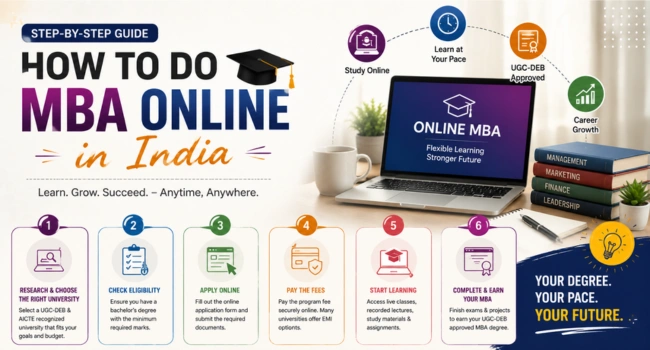


Doing an MBA online in India comes down to six steps: check your eligibility, pick a specialization, shortlist UGC-DEB approved universities, compare fees and accreditation, submit your application, and stay consistent once classes start. It sounds simple written out like that, but each step has a few decisions that genuinely affect the value you get out of the degree – so let’s go through them properly.
Step 1: Check Your Eligibility
Most online MBA programmes in India require a bachelor’s degree (10+2+3 or 10+2+4 pattern) from a UGC-recognised university, with a minimum of 45-50% aggregate marks. Reserved-category candidates (SC/ST/OBC/PwD) usually get a 5% relaxation. A handful of universities, like Manipal, also prefer at least one year of work experience for certain specializations, so check the specific programme page rather than assuming a blanket rule across every university.
Step 2: Decide Between Online, Distance, and Executive MBA
Before you shortlist universities, get clear on which format actually fits your situation:
Share Your Details for Free Consultation!
- Online MBA – live and recorded digital classes, completed in 2 years, best if you want a structured, interactive learning experience while working.
- Distance MBA – mostly self-study material with occasional weekend contact classes, usually 3-5 years, suited to independent learners who don’t need live digital sessions.
- Executive MBA – built for professionals with 8+ years of experience already in mid-to-senior management roles.
If you’re unsure, our Online MBA vs Distance MBA comparison breaks this down in more depth.
Step 3: Choose a Specialization Based on Career Goals, Not Just Interest
This is the step people rush through, and it shouldn’t be rushed. Pick a specialization by working backward from the job you actually want in 2 years, not just the subject that sounds interesting right now.
| If Your Goal Is… | Choose This Specialization |
|---|---|
| Investment banking, private equity, corporate finance | MBA in Finance |
| Brand, product, or digital marketing roles | MBA in Marketing / Digital Marketing |
| Data-driven decision-making roles across industries | MBA in Business Analytics |
| Talent strategy, people operations | MBA in Human Resource Management |
| Manufacturing, supply chain, logistics | MBA in Operations Management |
| Export-import, multinational firms | MBA in International Business |
Step 4: Shortlist UGC-DEB Approved Universities
Before you shortlist on brand name alone, confirm that the specific online MBA programme – not just the university – is UGC-DEB approved. This single check protects you from the biggest risk in online education: enrolling in a programme that turns out not to be recognised for jobs or further studies. Our Is Online MBA Valid in India guide walks through exactly how to verify this on the official UGC-DEB portal.
Once you’ve confirmed approval, compare universities on:
- NIRF Management ranking (where available)
- NAAC accreditation grade
- Total fees and available EMI options
- Specializations offered
- Whether they publish online-specific placement data (a good trust signal)
Our Top 10 Online MBA Colleges in India list is a good starting point for shortlisting.
Step 5: Compare Fees and Apply
Online MBA fees in India typically range from about INR 60,000 to INR 3,50,000 for the full 2-year programme, depending on the university and specialization. The application process itself is usually straightforward:
- Visit the university’s official admission portal (avoid third-party sites that ask for payment before you’ve confirmed the programme is genuine).
- Fill in your personal and academic details, and pay the application fee (typically INR 500-2,500, non-refundable).
- Upload scanned copies of your mark sheets, ID proof, and photograph.
- Select your specialization – some universities let you change this in the first semester if needed, so check the policy.
- Pay the semester or annual course fee through net banking, UPI, or card, using EMI if the university offers it.
- Wait for your confirmation email and LMS (Learning Management System) login credentials.
Most universities admit students on a merit or first-come-first-serve basis without an entrance exam, though a few (like IIM Ahmedabad’s BPGP) do require one. Always check the specific admission basis for your shortlisted university before applying.
Step 6: Set Yourself Up to Actually Finish It
The biggest risk in an online MBA isn’t the admission process – it’s finishing what you start. A few habits make a real difference:
- Block fixed study hours in your week rather than relying on “whenever I have time,” which tends to quietly disappear.
- Attend live sessions when offered instead of only relying on recordings – live sessions are where most of the real networking and doubt-clearing happens.
- Talk to your employer early if your MBA is relevant to your current role – some companies offer partial fee reimbursement or flexible hours for employees studying part-time.
- Use the placement cell proactively rather than waiting for it to reach out to you – online MBA placement support tends to reward students who follow up.
Documents You’ll Typically Need
- 10th and 12th mark sheets
- Bachelor’s degree mark sheets and provisional/final degree certificate
- Government-issued ID proof (Aadhaar/PAN/Passport)
- Recent passport-size photograph
- Category certificate (if applying under a reserved category)
- Work experience letter (if applicable to your chosen specialization)
FAQs
How to do MBA online after 12th?
You can’t go straight from 12th to an MBA – you’ll need to complete a bachelor’s degree first, since an MBA is a postgraduate qualification. Once you have your bachelor’s degree with the minimum required marks, you can apply directly to any UGC-DEB approved online MBA programme.
How to do MBA online while working full-time?
Choose a programme with recorded lecture access and flexible assignment deadlines, block fixed study hours in your week, and inform your manager early if the degree is relevant to your role – some employers offer schedule flexibility or fee support for this.
Do I need CAT or MAT to do an MBA online?
Usually not. Most online MBA programmes in India admit students on a merit basis (your graduation marks) without requiring an entrance exam. A small number of premium programmes, like IIM Ahmedabad’s BPGP, do require an entrance test.
How long does it take to complete an online MBA?
Most online MBA programmes take 2 years (4 semesters) to complete, though some universities offer accelerated or extended timelines depending on your pace.
Can I switch my specialization after starting an online MBA?
This depends entirely on the university’s policy – some allow a specialization change within the first semester, others lock it in at admission. Confirm this directly with your shortlisted university before applying if you’re unsure of your choice.
Also Read:
