
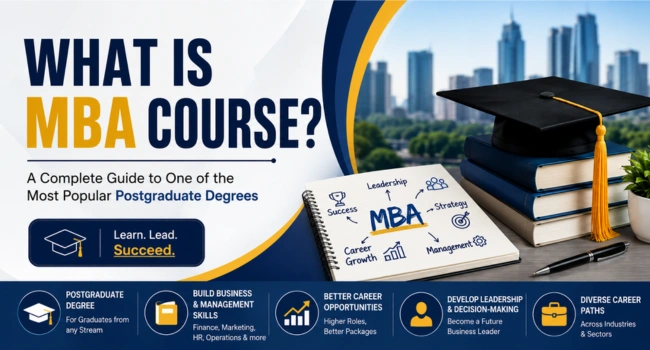


What is an MBA course? MBA stands for Master of Business Administration. It is a two-year postgraduate degree that trains graduates and working professionals in the core areas of running a business: finance, marketing, human resources, operations, and strategy. It’s the single most-chosen management degree in India, and the reason is simple – almost every corporate leadership role, from a startup founder to a CFO, expects the kind of structured business thinking an MBA teaches.
Top Indian institutions offering an MBA include the IIMs, FMS Delhi, IITs, NMIMS, IMT, and IIFT, among others. You can choose from specializations such as Marketing Management, Finance, Data Analytics, or HR to build depth in the area you actually want to work in, rather than a one-size-fits-all degree.
The MBA itself isn’t new – it traces back to early-20th-century America, and over a hundred years later it’s still the degree most professionals reach for when they want to move from an execution role into a leadership one.
Share Your Details for Free Consultation!
What is the Full Form of MBA?
The full form of MBA is Master of Business Administration. It is a a postgraduattion level degree, so you need a bachelor’s degree first before you can enroll. The “Business Administration” part covers exactly what it sounds like – how organisations are run, financed, marketed to customers, and staffed.
What is MBA Course in Hindi? (MBA क्या है)
MBA (Master of Business Administration) एक पोस्ट-ग्रेजुएट डिग्री है, जो बिज़नेस और मैनेजमेंट से जुड़े ज्ञान और स्किल्स सिखाती है। इसे हिंदी में “व्यवसाय प्रशासन में स्नातकोत्तर उपाधि” कहा जाता है। यह कोर्स फाइनेंस, मार्केटिंग, ह्यूमन रिसोर्स और ऑपरेशंस जैसे विषयों को कवर करता है, और उन students व working professionals के लिए बनाया गया है जो corporate sector में leadership role पाना चाहते हैं। भारत में MBA आमतौर पर 2 साल का होता है, हालांकि Distance और Online MBA में यह अवधि थोड़ी अलग हो सकती है।
What is the Use of MBA Course? Why Should You Do One?
An MBA is useful because it does three things at once: it gives you a wide-angle view of how a business actually functions, it builds leadership and decision-making skills that a purely technical degree doesn’t, and it puts you in a room (physical or virtual) with peers, faculty, and alumni who become part of your professional network for years afterward.
Beyond that, here’s what an MBA is actually useful for in practical terms:
- Career switching: engineers, doctors, and other non-commerce graduates use an MBA to move into management roles without starting over.
- Salary growth: a management degree on your resume is often the difference between an individual-contributor role and a team-lead or manager-level offer.
- Entrepreneurship: most MBA programmes teach business planning, financial modelling, and go-to-market strategy – the exact skills you need to start and run your own venture.
- Flexibility of format: unlike many degrees, MBA is offered full-time, part-time, online, and executive, so it fits your life stage instead of forcing you to fit the course.
The fees for a good MBA programme in India can look steep on paper, but when you compare the salary jump most graduates see afterward, the return on investment tends to justify the upfront cost for most career paths.
Types of MBA Courses (By Learning Mode)
MBA programmes aren’t one-size-fits-all when it comes to format. Here’s how the five main types differ, and who each one actually suits.
Full-Time MBA
This is the classic, on-campus MBA that most people picture when they hear the word. It runs for two years, and you attend classes daily as your only commitment – no job on the side. It suits fresh graduates or anyone who can afford to step away from full-time work for two years to focus entirely on studies, internships, and campus placements.
What is Online MBA Course?
An Online MBA lets you complete the entire degree remotely – live and recorded lectures, assignments, and exams, all delivered digitally, with the same UGC-recognised curriculum as an on-campus MBA. It’s built for people who need to keep working while they study, and it’s become the fastest-growing MBA format in India over the last few years because of its lower cost and complete location independence. Read our full guide on what an Online MBA covers, its fees, and top colleges.
What is Distance MBA Course?
A Distance MBA (also called part-time MBA) is UGC-DEB approved and typically requires attending occasional contact classes on weekends, alongside self-study material sent by the university. It usually takes longer to finish than an online MBA – often three to five years – and suits working professionals who want a recognised degree without needing fully live digital classes.
Executive MBA (EMBA)
An Executive MBA is built specifically for professionals with 8 to 15 years of work experience who are already in mid-to-senior management. Classes usually run in a cohort format – you progress through the programme with the same batch of experienced peers – and the schedule is designed around weekends or short intensive modules so it doesn’t clash with a demanding job.
Global MBA
A Global MBA leans into international business exposure – think study-abroad terms, cross-border consulting projects, and case studies pulled from multiple markets rather than just India. It’s aimed at students who want to work with multinational companies or in cross-cultural management roles after graduation.
What is the Best Course in MBA? (Top Specializations)
There’s no single “best” MBA specialization for everyone – the right one depends on your background and where you want to end up. That said, based on current hiring trends and salary data, these specializations consistently deliver the strongest outcomes:
- MBA in Finance – best for candidates aiming at investment banking, private equity, or corporate finance roles; consistently one of the highest-paying specializations.
- MBA in Marketing – a strong generalist choice with wide applicability across FMCG, retail, and D2C brands.
- MBA in Business Analytics / Data Science – the fastest-growing specialization right now, driven by demand for data-led decision-making across every industry.
- MBA in Human Resource Management (HR) – ideal if you want to work in talent strategy, organisational development, or people operations.
- MBA in Operations Management – suits engineers and candidates from manufacturing or supply-chain backgrounds.
- MBA in International Business – a good fit if you want to eventually work with export-import firms or multinational corporations.
Suggested Read: Top Online MBA Specializations to Pursue in 2026
MBA Course Subjects: Core and Elective
What you study in an MBA depends partly on your specialization and partly on the university, but almost every programme builds on the same foundation of core subjects before branching into electives.
Core Subjects
- Financial Management & Corporate Finance
- Marketing Management
- Human Resource Management
- Operations Management
- Business Statistics & Quantitative Analysis
- Organizational Behavior
- Strategic Management
- Business Communication
- Microeconomics
- Business Law & Ethics
- Financial Accounting
- Consumer Behavior
- International Business
- Project Management
- Leadership
Elective Subjects
- Digital Marketing
- Supply Chain Management
- Managerial Economics
- Financial Planning & Analysis
- Entrepreneurial Marketing
- Global Marketing
- Sustainable Governance & Ethics
MBA Course Syllabus (Semester-Wise)
1st year
| Semester 1 | Semester 2 |
|---|---|
| Tools and Frameworks of Decision-Making | Corporate Finance |
| Corporate Social Responsibility | Macroeconomics |
| Microeconomics | Business Law |
| Organizational Behaviour I | Organizational Behaviour II |
| Principles of Accounting | Optimization and Project Research |
| Business Communication and Soft Skills | Marketing Management |
| Principles of Marketing Management | Operations Management |
| Quantitative Methods and Statistics | Project Management |
2nd year
| Semester 3 | Semester 4 |
|---|---|
| Corporate Finance II | Internship / Live Project |
| Corporate Governance and Business Ethics | Strategic Management |
| Supply Chain Management | – |
| Managerial Economics | – |
| Financial Modeling | – |
| Business Intelligence | – |
| Marketing Research | – |
Scope of an MBA Degree
Once you finish an MBA, the degree opens doors across almost every industry – the core skills of finance, strategy, and people management translate everywhere. Here’s a sector-by-sector breakdown of where MBA graduates typically land.
Corporate Sector
This is where most MBA graduates end up, in roles like business development manager, financial analyst, marketing director, or operations manager. Companies specifically look for MBA graduates when a role needs someone who can manage complex, cross-functional business decisions rather than just execute a single function.
Entrepreneurship
If you want to start your own company, an MBA gives you a structured way to build a business plan, understand unit economics, and access founder-focused resources like campus incubators and investor networks that most programmes now offer.
Consulting
Management consulting firms hire MBA graduates specifically for their problem-solving ability – the job is essentially getting parachuted into a company’s operational or strategic problems and building a fix, which is exactly what MBA case-study training prepares you for.
Finance
An MBA with a finance specialization opens up investment banking, private equity, asset management, and financial analysis roles – all fields that specifically value the advanced financial modelling skills built during the programme.
Technology
Tech companies increasingly hire MBAs into product management, IT strategy, and digital transformation roles, where the job isn’t writing code but deciding what gets built and why.
Healthcare
As hospitals and pharma companies scale, they need people who understand both medicine-adjacent operations and business fundamentals – which is why healthcare administration and hospital management have become a growing MBA specialization.
Government and Nonprofits
Public policy bodies and NGOs also hire MBA graduates to bring structured resource planning and strategic thinking to sectors that don’t traditionally run like corporations.
MBA Course Salary in India
MBA graduates in India typically earn between INR 6,00,000 and INR 50,00,000 a year, though where you land in that range depends heavily on your specialization, the college you graduated from, and the company you join. A campus placement from a top-tier B-school will obviously sit at the higher end; a smaller regional college will sit closer to the lower end – but even the lower end comfortably beats most non-MBA entry-level roles.
Jobs and Salaries After an MBA
| Job Title | Average Salary (INR/Year) |
|---|---|
| Investment Banker | ₹10-40 Lakhs |
| Management Consultant | ₹8-35 Lakhs |
| Product Manager | ₹8-30 Lakhs |
| Chief Financial Officer | ₹20-50 Lakhs+ |
| Marketing Manager | ₹6-15 Lakhs |
| Finance Manager | ₹7-18 Lakhs |
| Business Analyst | ₹5-12 Lakhs |
| Human Resources Manager | ₹5-10 Lakhs |
| Operations Manager | ₹6-14 Lakhs |
| Sales Director | ₹12-30 Lakhs |
Top Colleges for MBA Course
Management is one of the most widely offered postgraduate fields in India, so the sheer number of colleges can be overwhelming. The right choice comes down to your budget, preferred learning mode, and career goals – here’s how the top options break down by format.
Top 10 Full-Time MBA Colleges in India (NIRF Ranking)
| Rank | College | State |
|---|---|---|
| 1 | IIM Ahmedabad | Gujarat |
| 2 | IIM Bangalore | Karnataka |
| 3 | IIM Kozhikode | Kerala |
| 4 | IIT Delhi | Delhi |
| 5 | IIM Calcutta | West Bengal |
| 6 | IIM Bombay | Maharashtra |
| 7 | IIM Lucknow | Uttar Pradesh |
| 8 | IIM Indore | Madhya Pradesh |
| 9 | XLRI – Xavier School of Management | Jharkhand |
| 10 | IIT Bombay | Maharashtra |
Top 10 Online MBA Colleges in India
This shortlist is built on curriculum quality, fees, faculty, and placement support – use it as a starting point, then dig into each university’s individual page before applying.
| S.N. | College/University | NIRF Management Rank |
|---|---|---|
| 1 | NMIMS Online | 21 |
| 2 | Amity Online | 29 |
| 3 | DY Patil Online | – |
| 4 | Symbiosis Online | 13 |
| 5 | Manipal Online | 73 |
| 6 | Amrita Ahead | 28 |
| 7 | Chandigarh Online | 36 |
| 8 | IGNOU Online | – |
| 9 | LIBA Online (Loyola Institute of Business Administration) | 66 |
| 10 | WeSchool (Welingkar Institute of Management) | 84 |
Which MBA Mode Is Most in Demand Right Now?
Since the pandemic, the Online MBA has clearly pulled ahead in popularity among working professionals. The reasons are practical rather than trendy: it costs less than a full-time programme, it doesn’t require quitting your job, and you can study on your own schedule instead of blocking out fixed classroom hours. That combination of affordability and flexibility is why online MBA enrolment has kept climbing for the past three to four years, even as full-time MBA remains the default choice for fresh graduates who can afford to study without an income.
Best MBA Courses for Commerce Students
If you’re coming from a B.Com or BBA background, these specializations tend to build most naturally on what you already know:
- MBA in Finance
- MBA in Human Resource Management
- MBA in Marketing
- MBA in Operations
- MBA in Event Management
- MBA in International Business
- MBA in Digital Marketing
- MBA in Data Science
FAQs on What is MBA Course
What is the full form of MBA?
MBA stands for Master of Business Administration – a postgraduate degree in business and management.
What is MBA course in Hindi?
हिंदी में MBA को “व्यवसाय प्रशासन में स्नातकोत्तर उपाधि” कहा जाता है। यह एक 2-वर्षीय पोस्ट-ग्रेजुएट डिग्री है जो बिज़नेस मैनेजमेंट, फाइनेंस और मार्केटिंग जैसे विषयों को कवर करती है।
What is the use of MBA course?
An MBA builds leadership, financial, and strategic decision-making skills, opens up management-level job roles across industries, and gives you a strong professional network – all of which typically translate into faster career growth and higher salaries than a bachelor’s degree alone.
What is the best course in MBA?
There’s no universal answer – MBA in Finance and Business Analytics currently offer the strongest salary outcomes, while Marketing and HR remain reliable, high-demand generalist choices. The best one for you depends on your background and career goal.
What is distance MBA course?
A Distance MBA is a UGC-DEB approved part-time format where you study mostly through self-paced material with occasional weekend contact classes. It usually takes 3 to 5 years and suits working professionals who don’t need fully live digital classes.
What is online MBA course?
An Online MBA delivers the complete MBA curriculum through live and recorded digital classes, letting you study from anywhere while continuing to work. It typically takes 2 years and follows the same UGC-DEB recognised structure as an on-campus MBA.
What is Management?
Management means getting a task or business objective done effectively and efficiently through people, resources, and planning – and MBA is the most popular academic path for learning it formally.
What is IIM?
Indian Institutes of Management (IIMs) are India’s premier public business schools, offering certificate, diploma, bachelor’s, master’s, and doctoral programmes, with their MBA courses being the most sought-after in the country.
What is BPGP MBA?
BPGP (Blended Post Graduate Programme) is an online, blended MBA format launched by IIM Ahmedabad specifically for working professionals and entrepreneurs. Read the full BPGP MBA guide here.
How long does an online MBA take to complete?
Most online MBA programmes take 1 to 4 years depending on the university and pacing structure. Some offer accelerated formats that finish faster, while others follow either an asynchronous (study-at-your-own-pace) or synchronous (fixed live-class) structure.
Also Read:
- Top 5 Online MBA Colleges in India
- What is an Online MBA? Full Details Guide
- NIRF MBA Ranking 2026
- Cheapest Online MBA in India
Approvals: AICTE and UGC. This site is not affiliated with the official Government of Samarth portal (samarth.edu.in). Fee, salary, and ranking figures are indicative and may change – please verify current details directly with the respective university before applying.
